Rare Male Genital Disorders: Small Penis Syndrome, Peyronie’s Disease, Penile Mondor’s Disease, And Diphallia - AI in Andrology from Etiological Profiling to ML-Driven Genomic Therapeutics
Keywords:
- Rare male genital disorders; Artificial Intelligence; Machine Learning; Precision Andrology; Genomic Therapeutics; Explainable AI.
Abstract
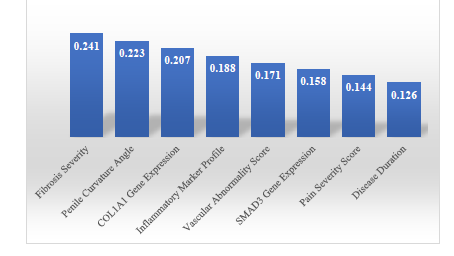
These are rare male reproductive diseases such as Small Penis Syndrome (SPS), Peyronie's Disease (PD), Penile Mondor's Disease (PMD), and Diphallia that have posed many difficulties in diagnosis and management due to their heterogeneous presentation. In this study, a novel Artificial Intelligence (AI)-powered precision andrology approach combining clinical, radiological, histological, and genomics data for diagnosis and management is proposed. A retrospective observational study on 240 participants was done using Supervised Machine Learning (ML)algorithms including Logistic Regression (LR), Support Vector Machine (SVM), Random Forest (RF),XGBoost, and LightGBM. SHAP Explainable AI (XAI) was used to select important predictors. Of all the testedmodels, XGBoost produced the best classification accuracy (97.4%), with a ROC-AUC of 0.989, while theaccuracy of gene-targeted therapeutic prediction was 97.2%. The three main biomarkers identified were fibrosisgrade, penile curvature angle, and expression level of COL1A1 genes. Statistical hypothesis testing showed thatartificial intelligence-based genomic analysis improves disease detection and individualized treatmentrecommendations (p < 0.001). It can be stated that integration of XAI with genomics is a reliable approach toprecision andrology. These results indicate that intelligent clinical decision support systems could be developedfor the treatment of rare male genital diseases in the future.