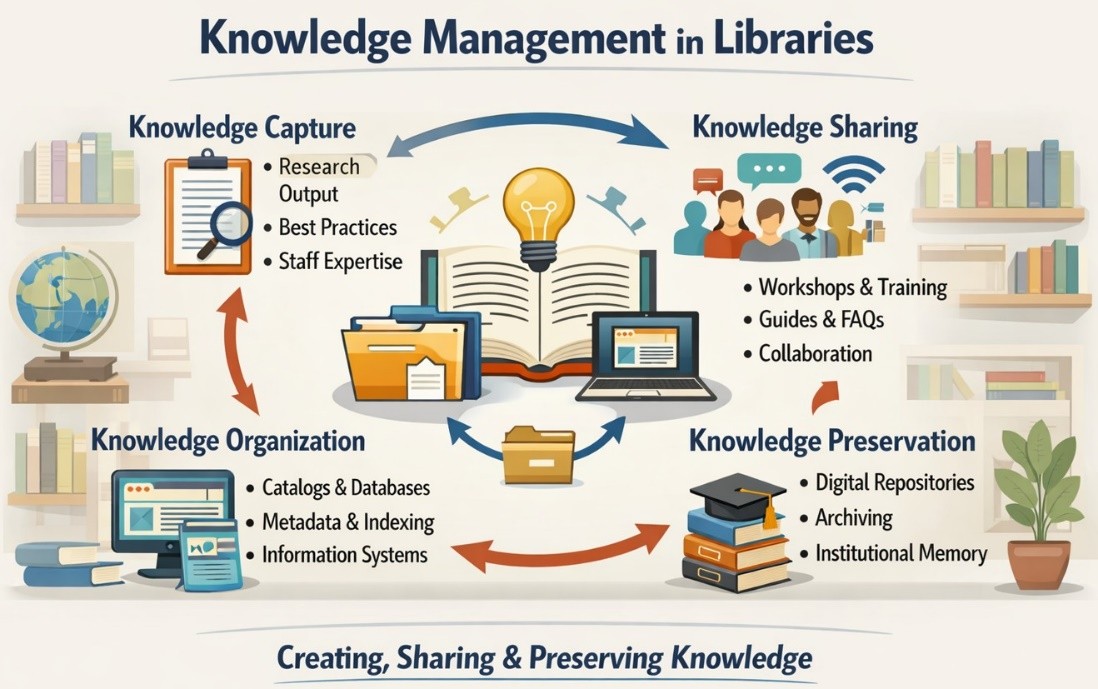
Knowledge Management Practices in Academic Institutions: A Library Science Perspective
Keywords:
- Knowledge Management; Academic Libraries; Library Science; Information and Communication Technology (ICT); Digital Repositories; Knowledge Sharing; Institutional Policy.
Abstract
Knowledge Management (KM) has become an essential strategic approach for academic institutions operating in a knowledge-driven environment. Academic libraries, as central knowledge hubs, play a critical role in facilitating knowledge creation, organization, storage, sharing, and utilization. The present study investigates knowledge management practices in academic institutions from a library science perspective, focusing on technological adoption, knowledge-sharing mechanisms, and policy frameworks. A descriptive quantitative research design was employed using a structured questionnaire administered to 120 respondents, including librarians, faculty members, and research scholars from five academic institutions. The findings indicate strong implementation of digital repositories and automation systems, reflecting effective knowledge storage practices. However, moderate scores in knowledge sharing and policy support highlight gaps in structured KM strategies. Correlation analysis revealed a significant positive relationship between ICT adoption and KM effectiveness (r = 0.68, p < 0.05). Institutions with formal KM policies demonstrated higher knowledge-sharing efficiency compared to those without structured frameworks. The study concludes that while technological infrastructure is well established, comprehensive knowledge management requires integration of policy support, collaborative culture, and strategic leadership. The research contributes to the field of Library and Information Science by emphasizing the evolving role of academic libraries as dynamic knowledge centers within higher education institutions.